Timothée Chalamet has long understood how to move through culture without appearing to chase it. That instinct was on full display in his viral Marty Supreme campaign, a moment that recalibrated how Hollywood, luxury, and influence now intersect.
On November 15, without warning or formal announcement, Timothée Chalamet uploaded a video to Instagram titled only video93884728.mp4. The clip appeared to show the Oscar-nominated actor pitching marketing ideas for Marty Supreme to a visibly confused A24 team over Zoom. It took several minutes and at least one abrupt “schwap!” to realize the meeting was staged. The “leak” was the campaign.
What followed was not a press rollout but a performance. The video quietly announced a marketing strategy that mocked the exhaustion of movie promotion while embracing its necessity. It did not explain itself. It trusted the audience to stay long enough to understand.
Why This Campaign Landed With Precision
Centered on restraint, not spectacle, the campaign felt less like advertising and more like an insider signal passed between those paying attention. The Timothée Chalamet Marty Supreme campaign arrived without explanation. No press junket. No forced narrative. Just imagery and attitude that felt lived in, not styled.
Shot with an editorial eye rather than a commercial one, the campaign leaned into ambiguity. Viewers were not told what to think. They were trusted to recognize the codes.
Seasoned observers noted how quickly it spread across private WhatsApp threads, group texts, and quiet corners of Instagram. Virality followed relevance, not the other way around.
Introduction — Marty Supreme (2025): A Modern Classic Arrives
Official trailer forMarty Supreme(2025). Video Credit: A24 Films YouTube channel
The new film Marty Supreme, starring Timothée Chalamet, hit theaters on December 25, 2025, with the same quiet audacity that defines its star’s cultural presence. Directed by Josh Safdie and loosely based on the life of table-tennis legend Marty Reisman, the film follows Marty Mauser, a young man from 1950s New York with an improbable obsession: becoming the greatest ping-pong player in the world.
Set against urban grit and theatrical ambition, the story unfolds as a blend of comedy, rivalry, and raw aspiration. The official trailer captures this tone precisely. Chalamet’s Marty rises from shoe-store clerk to underdog contender, confronting skepticism from every direction while pursuing a dream that no one else quite respects.
Performance Art Disguised as Marketing
Marty Supreme – Movie marketing as performance art. Post Credit: @tchalamet via Instagram
Hollywood campaigns often announce themselves loudly. This one did not. That restraint is precisely why it worked. Most studio campaigns aim for saturation. This one aimed for memorability.
Instead of press junkets and predictable interviews, Marty Supreme unfolded through stunts that felt improvised but were tightly controlled. Pop-up screenings appeared without notice. Chalamet arrived flanked by bodyguards wearing oversized orange ping-pong balls as helmets. Instagram Lives ran nearly silent, repeating only the phrase “Marty Supreme Christmas Day.”
One of the campaign’s most striking moments came when Timothée Chalamet made history by becoming the first person ever to appear atop The Sphere in Las Vegas — a feat so unexpected that many viewers didn’t immediately register what they were seeing. Standing on the exterior of the world’s largest spherical structure, Chalamet wore a custom Givenchy look that transformed the moment into a collision of cinema, fashion, and architectural spectacle. The image was instantly unforgettable, a feat of imagination that reframed movie promotion as a once-in-a-generation visual event.
Each moment felt absurd in isolation. Together, they formed a narrative. Marty Supreme borrowed from the language of independent cinema and underground fashion houses. The references felt intentional but never explanatory.
Hollywood’s Power Shift Is Already Underway
The Timothée Chalamet effect reflects a broader recalibration inside Hollywood. Traditional studio machinery is losing its monopoly on cultural authority.
Actors with taste, not just reach, now shape narratives. They choose projects and partnerships that align with how they actually live. The audience follows because it recognizes authenticity.
The campaign worked because it treated promotion as content rather than obligation. Chalamet did not simply star in the film. He embodied its obsession.
Highlights included:
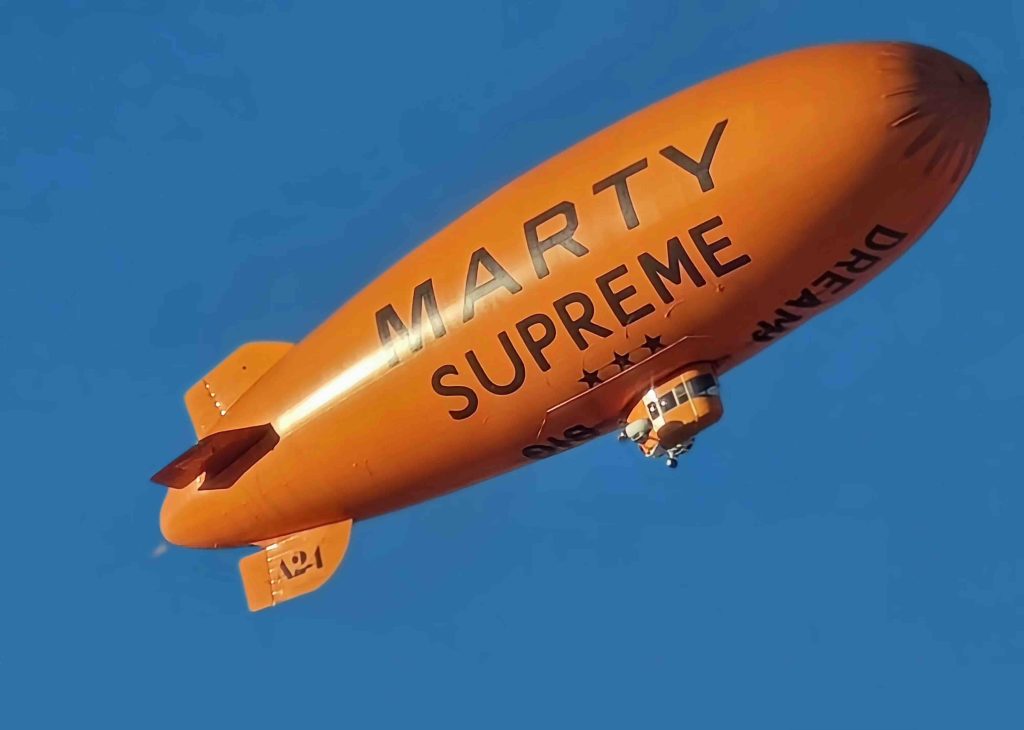
- A bright orange blimp hovering above Los Angeles
- A mock talent competition judged by Chalamet and his ping-pong “security”
- An ad series featuring cultural “GOATs” wearing branded windbreakers
- A deliberate refusal to explain the joke
The result was a campaign that demanded attention without begging for it.
Why This Resonated Now
What distinguishes Marty Supreme is that it does not feel like endorsement. It feels like alignment.
Marty Supreme built its legacy on scarcity and insider status. Timothée Chalamet understands those mechanics intuitively. The collaboration respected that lineage. Hollywood is facing a credibility problem. Traditional publicity feels rehearsed at a time when audiences reward spontaneity.
Marty Supreme acknowledged this fatigue directly. It made fun of marketing while doing it more aggressively than anyone else. That contradiction became the hook.
In limited release, the film delivered one of the strongest per-theater opening averages for an original film in nearly a decade. For a non-franchise release, that result was notable.
The Long Tail of Cultural Capital
Viral moments fade. Cultural positioning endures.
By aligning himself with Marty Supreme, Timothée Chalamet reinforced a reputation built on taste, not volume. That distinction increasingly defines longevity in Hollywood.
By turning movie marketing into something playful, strange, and unmistakably human, Timothée Chalamet reminded Hollywood that attention is earned, not engineered. The campaign respected time, intelligence, and curiosity.
This same understanding of cultural fluency and long-term value is a recurring theme explored throughout Ocean Blue World Magazine, where luxury is defined not by excess, but by discernment, access, and perspective. Those qualities still matter. Even now.